
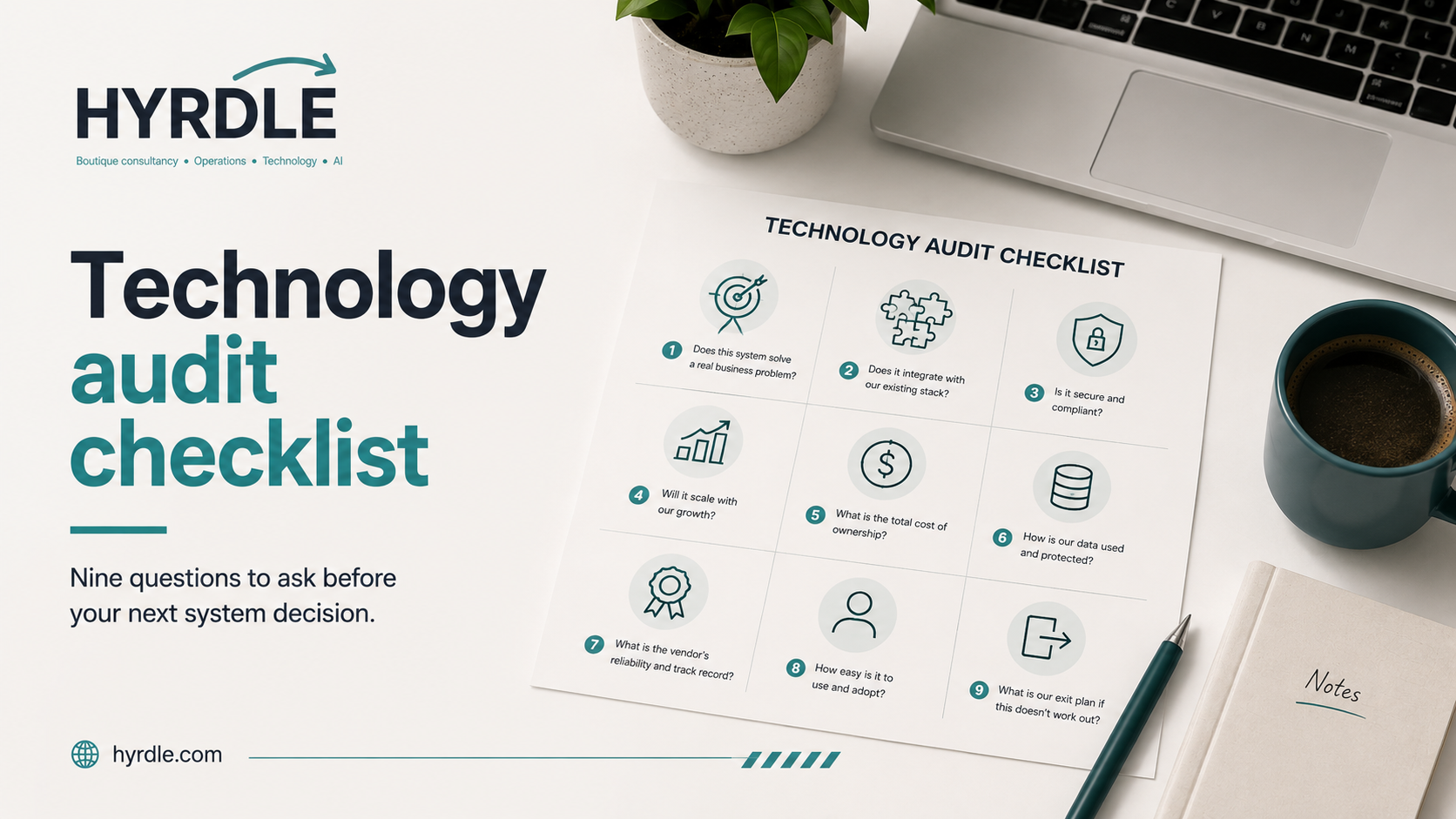
Technology audit checklist: nine questions to ask before your next system decision.
A structured checklist for founders who need to audit their current technology estate before committing to new tools or migrations.
Hyrdle Team
Management Consultancy
Most system decisions made inside founder-led businesses are made too quickly. A tool gets recommended by a peer, a vendor books a compelling demo, or the pain of the current setup becomes acute enough that something - anything - feels better than the status quo. The decision gets made, the contract gets signed, and six months later the team is carrying two systems instead of one.
A structured technology audit changes that pattern. Done properly, it forces a rigorous look at what the current estate is actually doing, where it is failing, and whether any proposed change genuinely addresses the root cause - or simply shifts the problem. It also surfaces the costs most founders underestimate: the engineering time spent on maintenance, the compliance exposure in legacy contracts, and the compounding drag of technical debt that quietly slows everything down.
This checklist is built for founders and senior operators who are approaching a system decision and want to make it on evidence rather than instinct. It is not a theoretical framework. It is the set of questions a senior practitioner would work through before advising any client to migrate, replace, consolidate, or hold. Work through them in order. The structure matters.
The nine questions are organised across eight sections, moving from audit setup through cost analysis to a final decision framework. By the end, you will have a documented, defensible position - not just an opinion.
Establishing the audit scope before you begin.
Before any question gets answered, the boundary of the audit needs to be drawn clearly. Define which systems, integrations, and tools fall within the scope of this specific audit, and which sit outside it. Trying to audit everything simultaneously produces nothing useful; a tightly scoped audit produces a decision. Be explicit about what is in and what is deliberately excluded.
Every component of the current technology estate needs an owner - a named individual who understands how that system is configured, what it connects to, and what breaks if it changes. Where there is no clear owner, that is itself a finding. Document ownership gaps as part of the scoping process, not as an afterthought.
The audit must be anchored to a specific decision. Set a clear decision trigger: what system choice, migration, or procurement is this audit informing? An audit without a concrete decision at the end of it tends to become a research exercise that delays rather than enables action. Name the decision explicitly before the first question is asked.
Finally, confirm the time horizon for any proposed change or migration. A system that is adequate for the next twelve months may be entirely wrong for thirty-six. The time horizon shapes how much weight to give scalability concerns versus immediate performance issues, and it prevents the audit from producing a recommendation that is technically correct but strategically misaligned.
Question 1–2: Assessing current system performance and fit.
The first question is the most direct: is each existing tool actively solving the problem it was adopted to solve? Not the problem as it was described in the original sales process, but the actual operational problem the team needed to address. Tools accumulate in founder-led businesses because each one solved a real problem at a specific moment. That problem may have changed shape, been absorbed by another system, or ceased to exist entirely. Confirm that each tool still earns its place.
Measure actual usage rates against licensing costs and capacity. Most technology estates contain licences being paid for that cover capabilities the team never uses, or seat counts that significantly exceed the active user base. This is not a marginal issue: it is common for 20–30% of a technology budget to be carrying unused capacity. Pull the data rather than estimating - actual login frequency, feature adoption, and active seat counts tell a clearer story than user surveys.
The third dimension of this section is friction mapping. Identify where the current estate creates friction for the team - the workarounds, the manual steps that exist because two systems do not talk properly, the data entry that happens twice - and where it genuinely delivers value. Both matter. A system that creates friction in one area may be delivering disproportionate value in another, and that trade-off needs to be visible before any replacement decision is made.
Question 3–4: Evaluating technical debt and integration health.
Catalogue every point-to-point integration in the current estate and assess the maintenance burden each one carries. Point-to-point integrations - direct connections between two systems, often built at speed to solve an immediate problem - tend to accumulate silently. Each one requires monitoring, occasional repair, and re-engineering whenever either connected system is updated. Map them explicitly, and note who currently maintains each connection and how much of their time it consumes.
Flag any systems running on legacy versions, deprecated APIs, or unsupported stacks. These are the components that introduce risk disproportionate to their size. A single system on a deprecated API can block an otherwise straightforward migration, or expose the business to a sudden outage when the vendor discontinues support. Identifying them early creates the option to plan; discovering them mid-migration creates a crisis.
Quantify how much engineering time - internal or contracted - is currently spent maintaining the existing tool estate rather than building new capability. In many founder-led technology teams, the proportion is higher than leadership recognises, because maintenance work tends to be invisible until something breaks. This number is a direct input to the cost-of-change calculation in Question 9, and it typically makes the case for consolidation more clearly than any vendor pitch.
Before committing to any migration, determine whether current integrations will survive the move intact. This is a step that is consistently underestimated. A migration that requires rebuilding four integrations from scratch carries a materially different cost and risk profile than one that does not, and the audit should surface that difference before the decision is made, not after the contract is signed.
Question 5–6: Stress-testing scalability and strategic alignment.
Check whether each system in the current estate can support the founder's next growth stage without requiring re-platforming. Re-platforming - migrating from one system to another under time pressure because the original tool hit a ceiling - is expensive, disruptive, and frequently avoidable with adequate planning. The audit should test each tool against the realistic growth scenarios for the next 12–24 months, not just the current operating state.
Audit vendor roadmaps for alignment with the company's direction. A vendor whose product is moving toward enterprise-scale complexity may be a poor fit for a founder-led team that needs simplicity and speed. Conversely, a vendor whose roadmap is static or unclear introduces strategic risk. Ask for roadmap documentation and assess it critically - vendor roadmaps are marketing as much as engineering plans, and they should be read accordingly.
Identify systems that are over-engineered for current scale. These tools impose configuration overhead, training requirements, and licence costs that are not returning equivalent value at the business's present size. Over-engineering is as much a problem as under-engineering - it drains resources, slows the team, and creates the illusion of sophistication without the corresponding capability. Where a simpler tool would serve the same purpose, the audit should say so plainly.
Confirm that the technology estate as a whole reflects current business priorities rather than historical ones. Founder-led businesses move quickly, and the system decisions made eighteen months ago may have been correct for a business that no longer exists in the same form. The audit is an opportunity to realign the estate with what the business is now, and where it is going - not to justify what was previously decided.
Question 7–8: Auditing security, compliance, and data ownership.
Verify data residency, access controls, and compliance posture for each system in scope. This is not a box-ticking exercise. For businesses operating across the UK and Europe, data residency requirements under UK GDPR and EU GDPR can differ, and assuming that a vendor's default configuration is compliant is an audit failure in itself. Pull the documentation, confirm where data is stored, and verify that access controls are configured to the standard the business actually requires rather than the vendor's default.
Confirm that the founder retains ownership and portability of all critical business data. This sounds obvious, but it is frequently not the case in practice. Some SaaS contracts grant the vendor broad rights over data generated within their platform, or impose export restrictions that make migration practically difficult even when it is theoretically permitted. Data ownership is a strategic asset, and the audit should confirm that it remains with the business.
Identify systems that introduce regulatory risk or lack adequate security documentation. A vendor that cannot produce a current SOC 2 report, cannot answer questions about penetration testing cadence, or whose security documentation is out of date is carrying risk that the business is absorbing by association. These findings should be rated seriously in the audit scoring, not treated as administrative details.
Check vendor contract terms specifically for data lock-in clauses before any migration commitment is made. Lock-in manifests in several forms: proprietary data formats that make export difficult, contractual restrictions on data use after termination, or pricing structures that penalise migration. Identifying these clauses before signing is the point of the audit. Discovering them after signing is a significantly more expensive problem.
Question 9: Calculating the true cost of change versus status quo.
Build a full cost inventory for any proposed change. Licensing is the number most founders start with, but it is rarely the largest. Implementation, data migration, integration rebuilding, team retraining, and the productivity downtime that occurs during any transition all carry real costs that need to be quantified. An audit that only compares licence fees is not a cost analysis - it is an incomplete picture that reliably underestimates the true cost of change.
Audit the hidden cost of inaction with equal rigour. Staying with the current estate is also a decision, and it carries costs that compound over time: technical debt that becomes progressively more expensive to address, integration maintenance that consumes engineering time, and the opportunity loss from capabilities the team cannot access because the current tools do not support them. These costs are less visible than a migration invoice, but they are no less real.
Compare total cost of ownership for the current estate against the proposed alternative across a consistent time horizon - typically three years gives a realistic picture without introducing excessive uncertainty. This comparison should be documented in enough detail that it can be reviewed and challenged. A recommendation that cannot withstand scrutiny is not a recommendation; it is a preference with numbers attached.
Use the audit findings to produce a go/no-go recommendation that is anchored explicitly in evidence. The recommendation should state what the audit found, what it recommends, and why - with the key data points visible. A senior stakeholder or investor reviewing the decision should be able to follow the reasoning without needing to ask clarifying questions. If the recommendation cannot be written in that form, the audit is not yet complete.
Running the audit as a founder: practical process guardrails.
Assign a single decision-maker who is accountable for the audit outcome. Audits with multiple nominally equal decision-makers tend to produce consensus documents rather than decisions. One person needs to own the conclusion, even if the review process is collaborative. That does not mean the decision is made unilaterally - it means accountability is clear.
Set a non-negotiable deadline for completing the audit, and treat it as a constraint rather than a target. Technology audits have a reliable tendency to expand until they consume the time available, generating thoroughness in place of decision. A deadline creates productive pressure and prevents the audit from becoming the reason the actual system decision is delayed rather than the thing that enables it.
Involve at least one technical and one operational stakeholder in reviewing each checklist question. Technical stakeholders will identify integration risks and infrastructure concerns that operational stakeholders may not see; operational stakeholders will surface team friction and workflow implications that technical reviewers may underweight. Both perspectives are needed, and the audit process should require both rather than allowing either to be skipped for speed.
Document all findings in a single source of truth that is accessible to every participant in the decision. Findings that live in separate email threads, separate documents, or individual notepads do not constitute a documented audit - they constitute a set of individual impressions that will be remembered differently by different participants. One document, maintained throughout, is the baseline requirement for a decision that can be defended and revisited.
Translating audit findings into a defensible system decision.
Score each checklist question with a clear red, amber, or green rating against defined criteria. The rating should be assigned based on the evidence gathered, not on the direction the business wants the decision to go. Red indicates a material problem that requires action; amber indicates a concern that warrants monitoring or mitigation; green indicates the system is performing adequately against that dimension. Consistency in how ratings are applied matters more than the specific criteria chosen.
Use the aggregate score across all nine questions to frame the decision in one of four directions: migrate to a new system, optimise the current one, replace it outright, or hold and re-evaluate at a defined future point. Each of these is a legitimate outcome. An audit that always recommends change is not an audit - it is a procurement process wearing different clothes. The hold recommendation, when the evidence supports it, is often the most valuable output the process can produce.
Define the minimum acceptable outcome that any new system or decision must deliver before it is considered successful. This standard should be set before implementation begins, not retrospectively once the results are available. Setting it in advance creates a clear basis for the 90-day review, prevents scope creep in what success is expected to mean, and makes it easier to identify early whether the decision is tracking as expected.
Establish a 90-day post-decision review to validate the audit's assumptions against what has actually occurred. No audit is a perfect predictor. Cost estimates will vary from actuals, integration complexity will differ from projections, and team adoption will not always follow the planned curve. The 90-day review is not an admission that the audit was wrong - it is the mechanism that turns a one-time decision into an ongoing, evidence-based practice. The assumptions documented during the audit become the baseline against which reality is measured.
---
A technology audit done properly is not a lengthy exercise - it is a disciplined one. The nine questions above will not take months to answer, but they will surface the information that most system decisions are made without: actual usage data, integration risk, compliance exposure, realistic cost of change, and a structured framework for reaching a conclusion that holds up to scrutiny.
If you are approaching a system decision and want a senior practitioner to work through this checklist with you - or to conduct an independent technology audit of your current estate - Hyrdle runs structured technology audits for founder-led businesses across the UK, Denmark, and Europe. Get in touch to discuss what your current estate needs before your next decision is made.
Not sure where your technology stands? Find out in 2 minutes - free.