
Seven business process automation examples that return hours to founder-led teams.
Concrete, role-specific automation scenarios illustrated with measurable outcomes, not vendor promises.
Hyrdle Team
Management Consultancy
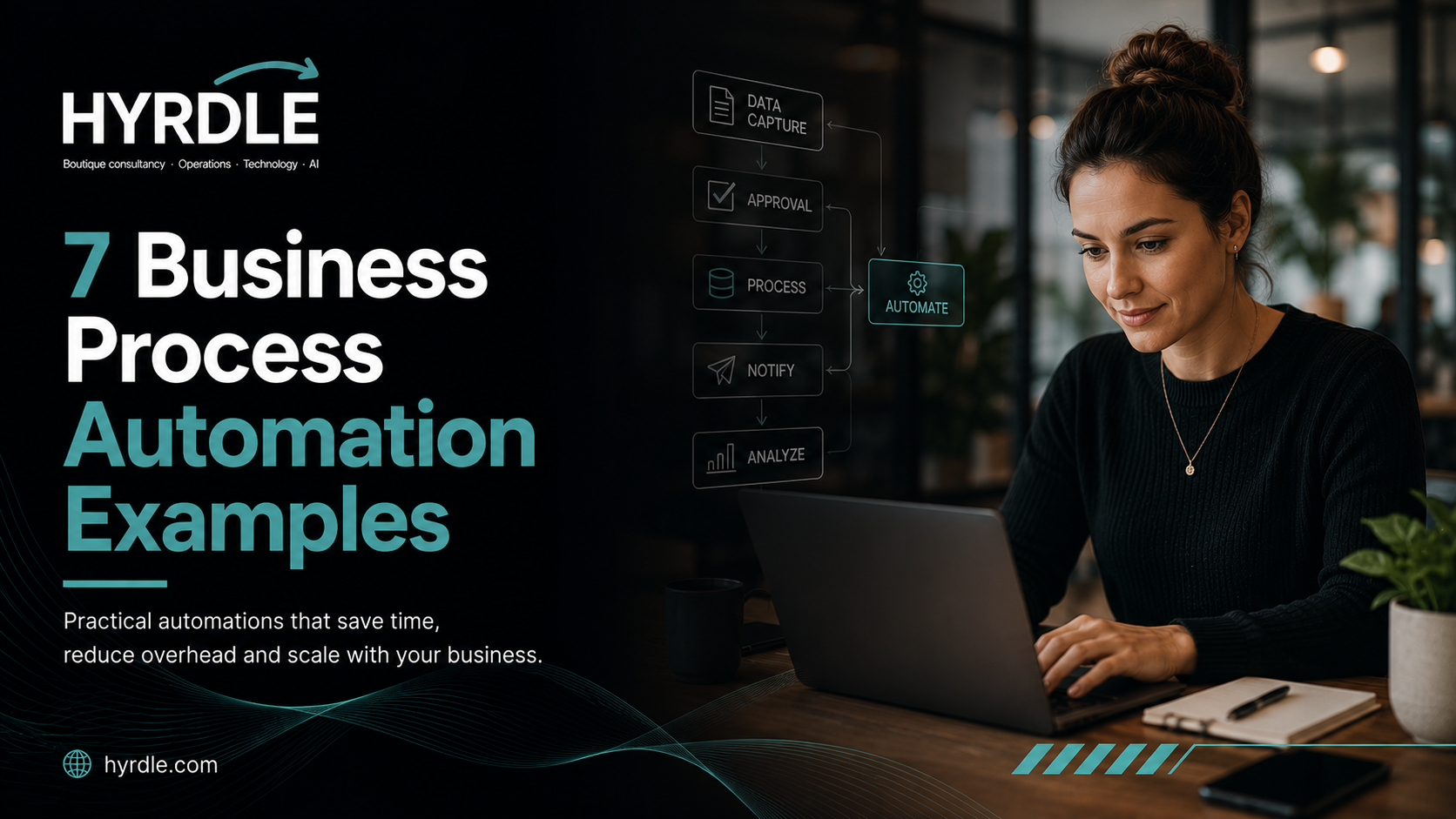
Automation is one of those words that accumulates hype faster than results. Vendors promise it will change everything; founders install a tool, wire up one workflow, and then wonder why they are still doing everything manually six months later. The honest answer is usually that the automation was too generic, too shallow, or too disconnected from the specific triggers and handoffs that actually slow a business down.
The examples below are not theoretical. They reflect the kind of work that genuinely returns time to founder-led teams - not because automation is magic, but because repetitive, rule-based tasks are genuinely poor use of a senior person's attention. Each example is grounded in a specific trigger, a specific outcome, and a realistic measure of time recovered.
If you are a founder who is still personally chasing invoices, manually routing new client documents, or sitting in a weekly stand-up just to gather status updates, at least one of these scenarios will feel familiar. The goal here is not to sell you on automation as a concept - it is to show you what it looks like when it is done with enough precision to produce a measurable result.
These seven examples are drawn from the operational patterns we see most often in scaling founder-led businesses. They are ordered by where the time loss tends to be most acute, not by complexity. Start with the one that costs you the most hours today.
Automated client onboarding sequences.
The trigger that makes onboarding automation genuinely useful is a contract signature, not a calendar reminder or a manual note to the team. When a contract is signed, every subsequent step - sending the welcome pack, requesting intake information, provisioning access, routing documents to the right team members - is entirely predictable. That predictability is what makes it automatable. A multi-step onboarding workflow initiated at the moment of signature means the founder does not need to intervene at any point in the sequence, and the new client receives a consistent, timely experience regardless of how busy the team is.
The measurable outcome here is a reduction in manual onboarding touchpoints per new client. A process that previously involved eight to twelve manual steps - emails written from scratch, documents sent individually, reminders tracked in a notebook - can be reduced to a single trigger event. The workflow handles the rest. We have seen onboarding time cut from 45 minutes of founder attention per client down to closer to five, once the logic is properly mapped and the routing is tested.
Task handoff logic is where most onboarding automations fall short if they are built hastily. It is not sufficient to send documents automatically if they land in a shared inbox and still require someone to manually route them. A well-constructed sequence knows which documents go to which role, which intake forms need completing before which credentials are issued, and which handoffs require a human decision versus which are purely mechanical. That specificity is the difference between automation that saves time and automation that just moves the manual work one step downstream.
When you aggregate the time recovered across a month of new client onboarding events, the figure is meaningful at the founder level. If a business signs four to six new clients per month and each previously consumed 30 to 45 minutes of founder attention, a properly automated sequence returns two to four hours per month - before accounting for the mental overhead of tracking where each onboarding is up to. That cognitive load is real, and it does not show up in a time-tracking tool.
Invoice generation and follow-up automation.
Invoice generation is one of the clearest examples of a task that should never require a founder's attention after the initial setup. The trigger is entirely predictable: a project milestone is reached, or a calendar date arrives. Either event can fire an invoice creation workflow without any manual input. The invoice is generated from a template, populated with the correct client details and line items, and sent - all without the founder opening a finance tool or drafting an email. The logic that makes this work is the same logic that makes it reliable: rules do not forget, and they do not delay because the founder had a busy week.
Automated payment reminder sequences operate on the same principle. Rather than a founder manually tracking which invoices are overdue and drafting individual chaser emails, the workflow monitors due dates and fires reminders on a pre-set schedule. The tone and content of each reminder can be calibrated - a gentle note at seven days, a firmer message at fourteen - without any human involvement between trigger and send. The founder only sees a notification when an invoice has remained unpaid past a defined threshold that requires a personal conversation.
The measurable outcomes from invoice and follow-up automation are among the most straightforward to quantify. Reduction in days-sales-outstanding is the headline figure: when reminders go out on time, every time, payment cycles shorten. The elimination of missed invoices - which happens more than founders like to admit when billing is tracked manually - removes a direct revenue leakage that is easy to overlook until you audit it. A business billing fifteen to twenty clients per month can easily miss one or two invoices in a quarter when the process is entirely manual.
The founder hours recovered per billing cycle compound quickly. If generating invoices, cross-checking them against project milestones, and manually sending reminders takes two to three hours per billing cycle, automation returns that time in full - and does so more reliably than any manual process. The follow-up sequences alone, which many founders either avoid or delay because chasing payment feels uncomfortable, are worth the automation effort on their own terms.
Recurring report assembly.
Reports that are produced on a regular schedule - weekly pipeline summaries, monthly financial snapshots, operational dashboards - share one structural characteristic: the data sources do not change. The same CRM, the same accounting tool, the same project management system provides the inputs every week or every month. That consistency is what makes automated report assembly straightforward in principle, even if the manual version of the task has become deeply habitual for the person who currently produces it.
The trigger is a scheduled pull: at a defined time, the automation collects data from the relevant sources and populates a pre-formatted report structure. The output lands in the right place - a shared folder, an email thread, a Slack channel - without anyone opening three tools, copying figures into a spreadsheet, and formatting the result. The manual version of this task is not difficult, which is precisely why it persists: it feels manageable right up until you add up how many hours it consumes across a year.
The measurable outcome is expressed in hours per week, and it tends to surprise founders when they calculate it honestly. A weekly report that takes 45 minutes to assemble manually, across 52 weeks, is 39 hours per year - nearly a full working week. A monthly report at two hours per cycle is 24 hours annually. Neither figure sounds alarming in isolation, but both represent time that could be directed at something that genuinely requires human judgement rather than data retrieval and formatting.
Accuracy improvement is the secondary outcome, and it is worth stating plainly. Human transcription errors in reports are common - not because the people producing them are careless, but because copying numbers between systems is not a task that commands full attention. Automated assembly removes the transcription step entirely. The data in the report is the data from the source, with no intermediate human handling. For any report that informs a decision - a board update, a client summary, a financial review - that accuracy improvement has a value beyond the hours saved.
Lead intake and qualification routing.
The window between a lead submitting an enquiry form and receiving a response is one of the most consequential gaps in a founder-led business. Research on lead response rates consistently shows that speed matters far more than most founders expect, and yet the typical manual process - form submission lands in an inbox, founder notices it when they next check email, founder reviews it and decides whether it is worth a conversation - introduces delays of hours or days. An automated intake and qualification workflow removes that delay at the point where it costs the most.
The trigger is the form submission or inbound enquiry itself. The moment it is received, scoring and routing logic fires: the lead's responses are evaluated against pre-defined qualification criteria, a score is assigned, and the lead is routed to the appropriate follow-up sequence or team member without any human review at that stage. A well-qualified lead receives an immediate, personalised acknowledgement and a prompt to book time. A lead that does not meet the criteria receives an appropriate response that does not consume founder attention.
The measurable outcome is a reduction in founder time spent on unqualified lead conversations, and this is often where the greatest time saving resides. Many founders spend a disproportionate amount of their week in discovery calls with prospects who were never a realistic fit - calls that would have been screened out immediately if qualification logic had been applied before the booking was made. Automating that screening step does not make the business less human; it makes the human conversations that do happen more valuable and better prepared.
Handoff to the appropriate team role or follow-up sequence completes the loop. Rather than a lead sitting in a shared inbox until someone manually assigns it, the routing logic ensures that the right person receives the right information at the right time. For a founder who is also the primary salesperson, this means the leads that reach them are already qualified, already contextualised, and already in motion - not waiting for a manual triage step that happens whenever there is a gap in the diary.
Employee or contractor offboarding.
Offboarding is the operational task that most founder-led businesses handle worst, not because it is complex, but because it is infrequent enough to lack a reliable process and consequential enough to cause real problems when it is incomplete. Access left active after a departure is a security exposure. Subscriptions not cancelled are a cost leakage. Documentation not completed is a compliance gap. None of these outcomes are acceptable, and yet they occur regularly in businesses that rely on a manual checklist that someone has to remember to open.
The trigger is a termination date or a status change in the HR or people management system. When that event is recorded, an automated offboarding workflow initiates: a checklist is generated, notifications are sent to the relevant parties, and the sequence of revocation and documentation tasks begins. The automation does not complete every step itself - some steps require a human action, such as a final conversation or the physical return of equipment - but it ensures that no step is overlooked because it was not on the mental list of whoever was managing the departure.
The measurable outcome is a reduction in overlooked access points, and this is where the security and cost exposure argument is most direct. A business using twelve to fifteen software tools - which is not unusual for a scaling team - has twelve to fifteen places where access needs to be revoked when someone leaves. Manual tracking of that list is unreliable. Automated removal, triggered by the offboarding workflow, ensures that each tool is addressed in sequence, with confirmation logged against the record.
Founder hours eliminated per offboarding event are meaningful even if offboarding is infrequent. A single manual offboarding process - coordinating access revocation, chasing documentation, confirming subscription cancellations - can consume two to three hours of senior time when it is handled reactively. An automated sequence reduces that to a review and sign-off step, with the mechanical work already completed. At even four to six offboarding events per year, the time saving is material, and the reduction in risk exposure has a value that is harder to quantify but no less real.
Accounts payable and expense reconciliation.
Expense reconciliation at the end of a month or quarter is one of those tasks that is genuinely low-value but stubbornly time-consuming. The manual version involves collecting receipts from multiple people, categorising each expense, matching it to the correct project or budget line, routing it for approval, and eventually reconciling the total against the accounts. Each individual step is mechanical. None of it requires judgement. All of it takes time - and tends to accumulate into a significant block of work precisely when the team is already busy with period-end tasks.
The trigger for an automated accounts payable workflow is the submission of a receipt or vendor invoice. From that point, categorisation logic is applied based on the vendor, the amount, and any reference codes included in the submission. The expense is matched to the relevant budget or project, routed for approval to the appropriate person, and logged against the accounts - without anyone manually performing those matching and routing steps. The approver receives a clean, categorised request rather than a raw receipt, which accelerates the approval step as well.
The measurable outcome is hours saved per month on reconciliation, and this is one of the areas where the saving compounds most visibly over a financial year. Businesses that currently spend four to six hours per month on manual expense reconciliation - a conservative estimate for a team of ten to fifteen - recover that time in full when the categorisation and matching steps are automated. The end-of-period reconciliation becomes a review task rather than an assembly task, which is a fundamentally different demand on the finance lead's time.
Reduction in late payment penalties is the secondary outcome, and it is directly attributable to automated due-date routing. When vendor invoices are processed and routed on receipt rather than accumulated in an inbox until someone has time to review them, payment deadlines are met consistently. Late payment penalties and strained supplier relationships are both avoidable costs; automated routing removes the manual dependency that allows them to occur.
Internal status update and stand-up reporting.
The weekly stand-up meeting exists to answer a small number of factual questions: what did each person complete, what are they working on, and is anything blocked. These are questions that can be answered asynchronously, and in most teams, they are answered in the meeting itself - which means the meeting is the data collection mechanism, not a forum for decisions or discussion. Replacing that data collection step with a scheduled automation does not remove the team's ability to discuss meaningful issues; it removes the overhead of gathering routine status information in real time.
The trigger is a scheduled prompt - sent at a consistent time each week - that asks each team member for their status inputs. The responses are collected, compiled into a summary format, and delivered to the relevant channel or document automatically. The founder and team lead receive the assembled update without convening a meeting to gather it. Issues that require discussion are flagged; routine progress is documented without consuming anyone's time beyond the two to three minutes it takes to submit a response.
The measurable outcome is meeting minutes reduced per week and asynchronous visibility increased across the team. A 30-minute weekly stand-up with a team of six is three hours of collective time per week - 156 hours per year. Even if the meeting continues in a reduced form for genuine discussion, removing the status-gathering function from it reduces its length and frequency. For distributed or hybrid teams, the async format also produces a written record that a live meeting never provides.
Founder time reclaimed from coordination tasks is the figure that matters most at the individual level. A founder who previously spent 30 to 45 minutes per week gathering status updates - through the meeting, through follow-up messages, through ad hoc check-ins - recovers that time when the workflow collects and compiles the information automatically. At scale, as the team grows and the coordination surface increases, the value of this automation grows with it. Coordination overhead is one of the most consistent drains on founder capacity as a business scales, and automated status collection is one of the more straightforward ways to contain it.
---
These seven automation scenarios share a common structure: a specific trigger, a defined sequence of mechanical steps, and a measurable outcome expressed in time or money recovered. None of them require a large technology investment or a lengthy implementation project. What they do require is a clear map of the current process, an honest assessment of where the manual steps are, and enough precision in the automation design to ensure that the workflow handles the edge cases correctly.
If you are a founder who recognises two or three of these patterns in how your business currently operates, the starting point is not a tool selection decision - it is a process audit. Knowing exactly where your hours are going, and which of those hours are genuinely replaceable with well-designed automation, is the work that precedes any sensible technology choice.
Hyrdle works with founder-led teams to map, design, and implement automation that produces results you can measure. If you would like a senior-led review of where automation could return the most time to your business, get in touch to arrange a consultation.
Not sure where your technology stands? Find out in 2 minutes - free.