
AI readiness assessment: what it measures and why most businesses skip it too soon.
A practical guide to what a genuine AI readiness review actually covers, and why bypassing it reliably wastes budget.
Hyrdle Team
Management Consultancy
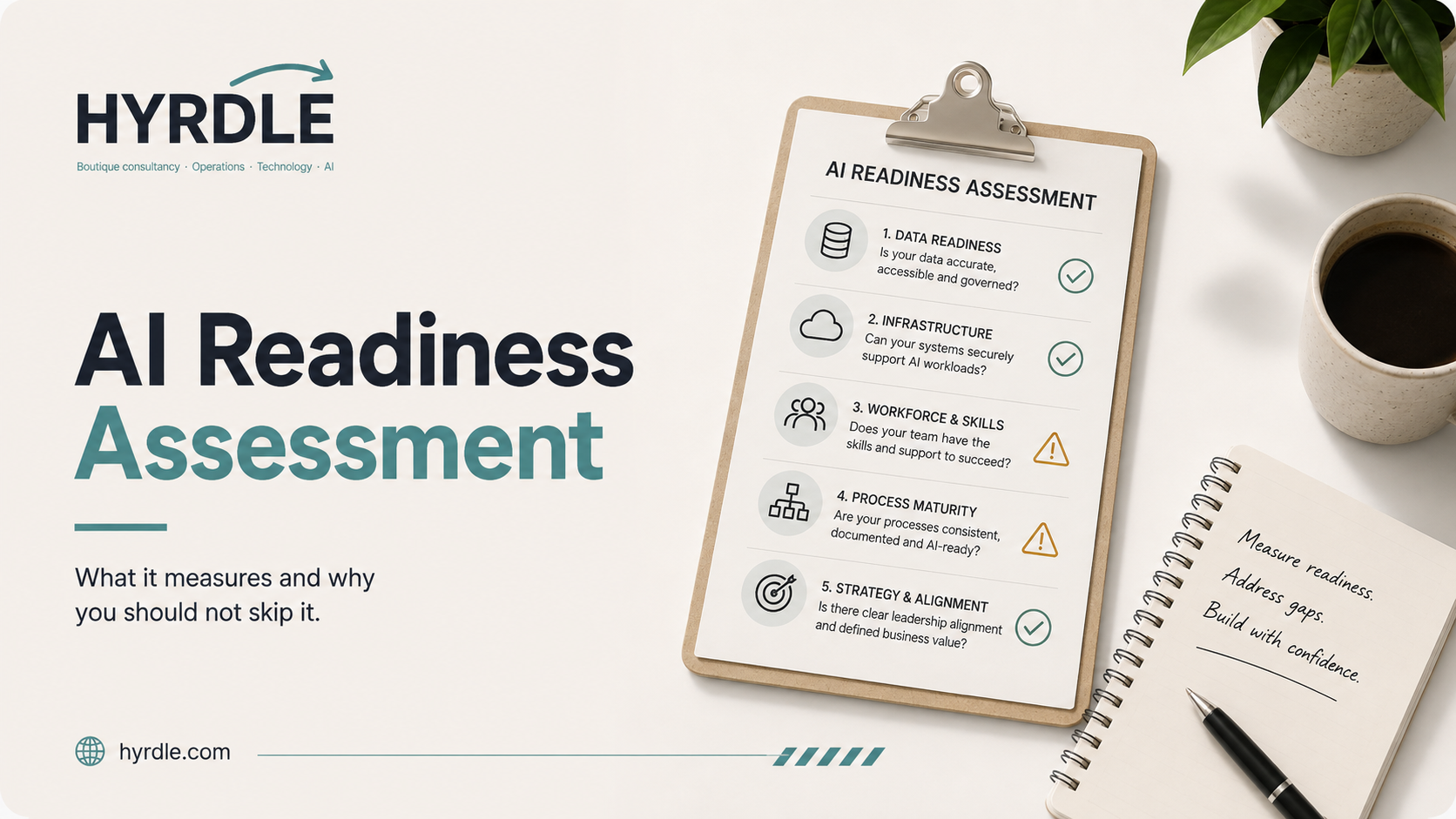
Most businesses that struggle with AI implementation did not fail at the technology. They failed earlier - at the point where someone decided the organisation was ready when it was not. An AI readiness assessment is the structured process that answers the question of whether a business can genuinely support an AI deployment before any vendor is selected or any budget committed. It is not a formality, and it is not a checklist generated to justify a project that has already been approved. Done properly, it is a frank diagnostic that either gives you confidence to proceed or tells you, with evidence, what needs to change first.
The discomfort around readiness assessments is understandable. They slow things down at a moment when leadership is often impatient to show progress. Vendors have little commercial incentive to surface gaps that might delay a sale. And the outputs of a rigorous review are not always flattering - particularly when they reveal that the data, the infrastructure, or the workforce are not where they need to be. But the alternative is worse: projects that absorb significant budget, encounter entirely predictable problems mid-implementation, and produce outcomes that fall well short of what was promised.
This guide sets out what a genuine AI readiness assessment covers across five critical dimensions, explains why the criteria matter, and documents the specific stages that businesses routinely rush past - and what that rushing costs them. The aim is not to make AI adoption sound harder than it is, but to be straightforward about what separates implementations that deliver from those that do not.
If you are evaluating whether your organisation is prepared to move forward with an AI project, or if you are reviewing a project that has already stalled, the criteria below are the right place to start.
What a genuine AI readiness assessment actually covers.
A rigorous readiness assessment does not begin with technology. It begins with data quality, availability, and the governance standards that have to be in place before any AI system can function reliably. AI models - whether off-the-shelf or custom - depend entirely on the quality of the data they process. If that data is incomplete, inconsistently formatted, poorly labelled, or governed in ways that restrict access, the model's outputs will reflect those problems directly. Assessing data readiness means auditing not just what data exists, but whether it meets the standards required for the specific use case being considered.
Beyond data, the assessment covers infrastructure capacity and integration compatibility with existing systems. An AI tool does not operate in isolation - it needs to connect to the systems, databases, and workflows already in place. Whether the current environment can support those connections, handle the associated compute requirements, and maintain performance under AI workloads is a technical question that has to be answered before implementation begins, not during it.
A workforce skills inventory and organisational capability gap analysis forms the third pillar of a genuine assessment. AI adoption changes how people work, and the degree to which a team has the literacy and technical skills to operate, govern, and interpret AI outputs varies considerably. Overlooking this dimension does not make the gap disappear - it surfaces later, as adoption problems, resistance, or governance failures.
Process maturity is assessed alongside workforce capability. Not every workflow is suitable for AI augmentation, and not every workflow that is theoretically suitable is mature enough to support it in practice. Processes that are inconsistent, poorly documented, or dependent on informal workarounds introduce unpredictability that AI systems amplify rather than resolve. The assessment maps current process maturity against the requirements of the proposed AI use case.
Finally, leadership alignment and clarity of business objectives tied to specific AI use cases is assessed directly. AI projects that lack a defined problem statement - where the objective is to adopt AI rather than to solve a particular operational challenge - consistently underperform. The assessment surfaces whether leadership has agreed on what success looks like, and whether the proposed use cases are connected to that definition.
Data readiness criteria within the assessment.
Volume, labelling, and cleanliness thresholds are the starting point for any data readiness review. Training or deploying an AI model requires data that meets minimum quantity standards, is labelled with sufficient consistency for the model to learn from it, and is clean enough that errors do not propagate into outputs. These thresholds vary by model type and use case, but they are never negligible - and in most organisations, the gap between available data and deployment-ready data is larger than expected once a proper audit is conducted.
Data pipeline reliability is assessed alongside the static quality of stored data. An AI system that depends on data fed from operational systems is only as reliable as those pipelines. If data is ingested inconsistently, if pipeline failures go undetected, or if there is no monitoring in place for feed quality, the AI system will behave unpredictably. The assessment examines whether the infrastructure around data movement is robust enough to support ongoing AI operations, not just an initial deployment.
Compliance and data residency requirements shape what data can actually be used. This is a dimension that organisations frequently underestimate, particularly when operating across jurisdictions with different regulatory frameworks. GDPR obligations in Europe, sector-specific data handling requirements, and data residency rules that restrict where data can be processed all constrain what an AI system can legitimately access. Assessing these requirements before deployment is not optional - discovering them mid-project forces expensive redesign.
An audit of siloed data sources is included because data that cannot be connected cannot be used. Most organisations carry data across multiple systems that do not communicate with each other - CRMs, ERPs, finance platforms, operational tools, and spreadsheets held by individuals. A functioning AI implementation typically depends on drawing from several of these sources coherently. Where those sources are siloed and integration is absent, the assessment identifies the extent of the problem and what resolution requires.
Infrastructure and integration criteria.
The assessment examines on-premise versus cloud environment compatibility with the target AI solutions under consideration. Many AI platforms are designed primarily for cloud environments and carry limitations - or significant configuration overhead - when deployed on-premise. Where an organisation's infrastructure is primarily on-premise for regulatory or legacy reasons, the assessment identifies which AI solutions are genuinely compatible and which would require infrastructure investment before deployment could proceed.
API availability and system interoperability across the current technology stack is assessed because AI tools do not replace existing systems - they connect to them. If the systems in current use do not expose APIs, or if those APIs are limited in scope, the integration work required to make an AI deployment functional can dwarf the cost of the AI tool itself. The assessment maps what is available, what is missing, and what integration complexity a given implementation would carry.
Latency, compute, and storage benchmarks are reviewed against the requirements of the proposed AI workloads. Some AI applications - particularly those involving real-time inference or large model processing - have compute and latency requirements that existing infrastructure cannot meet without upgrade. Identifying this before a vendor is selected allows budget planning to include infrastructure costs rather than discovering them as overruns partway through a project.
Security architecture is reviewed specifically for vulnerabilities introduced by AI system access. Connecting an AI system to operational data and processes creates new attack surfaces. The assessment examines whether existing security controls are adequate for those new access points, whether AI system credentials and data access are appropriately scoped, and whether the organisation has the monitoring capability to detect anomalous behaviour from AI-connected systems.
Organisational and workforce criteria.
The assessment conducts a role-by-role review of AI literacy and technical skill requirements. This is not a blunt categorisation of who is and is not comfortable with technology. It is a specific mapping of what each role will need to do differently once an AI system is in place - and whether the current occupants of those roles have the skills to do it. Where gaps are identified, the assessment distinguishes between gaps that can be closed through training, gaps that require new hiring, and gaps that are significant enough to affect implementation sequencing.
Change management readiness and employee resistance risk indicators are assessed as a distinct dimension. AI adoption changes workflows, and in many cases it changes how individual performance is measured or how decisions are made. The assessment examines whether the organisation has the change management capability and communication practices in place to support that transition, and identifies roles or teams where resistance risk is elevated - not to dismiss those concerns, but to address them deliberately.
The availability of internal ownership for ongoing AI model governance is assessed because deployment is not the end of the project. AI systems require ongoing monitoring, performance review, and governance to remain effective and compliant. The assessment identifies whether there is a credible candidate for that ownership role internally, whether that person has the time and authority to fulfil it, and whether governance processes exist or need to be built.
Budget allocation structures that can sustain post-deployment maintenance are examined because the cost of an AI implementation does not end at go-live. Model performance degrades over time, data distributions shift, regulatory requirements change, and integrations require maintenance. The assessment reviews whether budget planning has accounted for these ongoing costs, and flags where it has not - because projects that run out of maintenance budget typically run out of value shortly afterwards.
How skipping the assessment creates budget waste.
Premature vendor selection is one of the most common and expensive consequences of bypassing a readiness assessment. When a business selects an AI vendor based on feature demonstrations rather than organisational fit, the decision looks reasonable at the time. The product is capable, the demos are compelling, and the sales process is efficient. What is absent from that process is any rigorous examination of whether the organisation's data, infrastructure, and workflows can actually support the product. The resulting mismatch surfaces after contracts are signed and implementation begins.
Implementation failures traced directly to unresolved data quality problems are well documented in practice. Data issues that would have been identified in a readiness assessment - incomplete records, inconsistent formats, unlabelled training data - do not disappear when an AI project launches. They appear as model outputs that are unreliable, outputs that require extensive human correction, or, in the most serious cases, outputs that are simply wrong in ways that take time to detect. The cost is not just the data remediation work; it is the implementation time lost and the credibility damage to the project.
Rework costs generated when integration incompatibilities surface mid-project are a direct consequence of skipping infrastructure assessment. An integration that looks straightforward at the procurement stage - connecting an AI tool to an existing CRM or ERP - frequently reveals complexity once implementation begins. APIs that are undocumented, data models that do not align, or authentication requirements that conflict with existing security policy all generate rework that was not budgeted. These costs are avoidable when infrastructure compatibility is assessed before vendor selection.
Sunk costs from deploying AI into processes that are not mature enough to support it represent a subtler but equally real form of budget waste. A process that is inconsistent in its inputs, dependent on exceptions handled informally, or reliant on individual judgment that has never been documented is not a candidate for AI augmentation until those underlying issues are resolved. Deploying AI into an immature process does not mature the process - it typically amplifies its inconsistencies at scale, producing outputs that are both unreliable and difficult to diagnose.
The specific stages businesses rush past and why.
Pressure from leadership to show AI progress drives premature procurement across a wide range of organisations. When AI adoption becomes a visible strategic priority - reported to boards, discussed in investor conversations, or positioned in market communications - the internal pressure to demonstrate tangible action builds quickly. Procurement of a visible AI tool satisfies that pressure in a way that a readiness assessment does not. The assessment produces a document; the procurement produces a contract and a launch date. The incentives, in the short term, point consistently toward the latter.
Vendor sales cycles are structured in ways that minimise readiness gaps rather than surface them. A vendor whose revenue depends on deal closure has a commercial interest in presenting the implementation path as straightforward. Readiness concerns that emerge during a sales process are managed with reassurances - that integration is simpler than it looks, that data migration is handled, that change management is supported. These reassurances are not always wrong, but they are consistently optimistic, and they are not a substitute for an independent readiness review.
Misreading pilot success as full organisational readiness for scaled deployment is a stage that many businesses rush past with genuine confidence rather than impatience. A pilot succeeds in a controlled environment - carefully selected data, willing participants, senior sponsorship, and a team focused on making it work. Those conditions are not representative of a full deployment. Scaling from a successful pilot to an organisation-wide implementation exposes all of the data, infrastructure, and workforce gaps that the pilot conditions obscured. The assessment prevents that gap from being discovered at scale.
Workforce assessment is frequently skipped because it is perceived as a slower, softer step than technical evaluation. Infrastructure can be benchmarked; data can be audited; APIs can be tested. Assessing workforce capability and change readiness requires interviews, observation, and judgment - and the outputs are less precise. In organisations that prioritise speed, the workforce dimension is typically deprioritised or conducted superficially. The consequence is that AI tools are deployed into teams that do not have the skills to use them effectively, or into cultures that resist them actively.
How assessment criteria map to implementation risk levels.
A structured readiness assessment does not simply list gaps - it scores them against the probability of project failure at each implementation stage. A data quality gap, for example, carries different risk depending on whether the AI use case depends on real-time inference or batch processing, whether training data is involved, and whether the gap can be closed in weeks or months. Scoring each criterion against failure probability allows the assessment to produce a risk-weighted view of the project rather than an undifferentiated list of issues.
Infrastructure deficits are weighted by the cost and time required to remediate them. An infrastructure gap that requires six months of investment and a significant capital commitment carries different weight in the project plan than one that can be resolved with a cloud environment configuration. By quantifying remediation requirements, the assessment enables genuine budget planning rather than optimistic estimation, and it allows leadership to make an informed decision about whether the infrastructure investment is justified by the expected return.
Workflow maturity findings that directly block minimum viable deployment are prioritised within the assessment output. Not every finding requires resolution before implementation begins - some can be addressed in parallel, and some are relevant only to later phases of a scaled deployment. The assessment identifies specifically which findings block the minimum viable case, enabling a sequenced approach that moves forward where it safely can while addressing blockers in parallel.
Assessment outputs are used to sequence implementation phases by risk exposure. Rather than a binary go/no-go decision - which organisations often resist because it delays the project entirely - the assessment produces a phased sequence that allows implementation to begin in areas where readiness is confirmed while remediation proceeds in areas where it is not. This approach manages risk without requiring organisations to defer the entire programme, and it ensures that each phase begins from a documented baseline of readiness.
What a completed assessment produces before implementation begins.
The primary output of a completed readiness assessment is a documented readiness score across each criterion category, with gap identification at the level of specificity required to act on it. The score is not a single number - it is a profile across data, infrastructure, organisation, and process that shows where the business is prepared to proceed and where it is not. That profile becomes the reference document for all subsequent implementation planning decisions.
A remediation roadmap is produced alongside the readiness score, with defined actions required before deployment proceeds on each dimension where gaps were identified. The roadmap distinguishes between actions that are prerequisites for any deployment and actions that can be addressed in parallel with early implementation phases. It assigns ownership, indicates indicative timelines, and flags dependencies - so that the path from current state to deployment-ready is documented rather than assumed.
A realistic budget estimate that accounts for pre-implementation gap-closing work is produced as part of the assessment output. Most implementation budgets are built from vendor pricing and internal resource estimates without accounting for the cost of resolving the gaps that the assessment identifies. The result is a budget that looks adequate at approval and proves insufficient in execution. The assessment-derived budget includes data remediation, infrastructure investment, integration development, and workforce preparation costs alongside the implementation itself.
A go/no-go framework is produced that ties implementation authorisation to specific readiness thresholds. Rather than leaving the decision to proceed to informal judgment, the framework defines the criteria that must be met before each implementation phase is authorised. This protects the project from the pressure to proceed before conditions support success, and it gives leadership a principled basis for a deferral decision that is grounded in evidence rather than caution.
---
If you are planning an AI implementation and the readiness assessment has not been completed - or has been completed only superficially - the risk profile of that project is higher than it needs to be. Hyrdle works with founders and scaling businesses across Denmark, the UK, and Europe to conduct structured, senior-led AI readiness assessments that produce actionable outputs rather than documents that sit unread. If you would like to understand where your organisation genuinely stands before committing further budget, get in touch to arrange a consultation.
Not sure where your technology stands? Find out in 2 minutes - free.